Not that help was needed to formulate an original thought regarding what’s thematically most important about a film, but the star of Train Dreams, Joel Edgerton, did tap into something that resonated quite positively during a recent Q&A following a screening of the film. While audiences often go to the cinema to be transported by filmmakers and actors to a scenario that usually has them following the perspective of an individual living a more fantastical life in some way, there’s just as much to gain from watching an everyman’s life, let alone their struggles. The ordinary instances in one’s life, whether it be a first love or the death of someone close, can feel just as epic as any number of complicated scenarios found in films designed to highlight spectacle (and both are acceptable forms of filmmaking). Following a regular man in the world is not unique to Train Dreams, but the film does provide an excellent look at a man whose life contains various forms of drama, captured with a sense of naturalism that left a lasting mark.
Edgerton stars as Robert Grainier, a logger who helped build the railroads across the United States during the late 19th century and into the 20th. We learn early on that Robert came from nowhere. His parents disappeared at some point for undisclosed reasons, and he grew up on his own in frontier land, becoming a decent man who works hard. He would eventually marry Gladys (Felicity Jones), and the two would have a child together. Drama essentially forms around the dangerous conditions of Robert’s work, as well as the large amounts of time spent away from his family during prime logger season.
See Also: ‘Roofman’ Review: Catch Channing If You Can
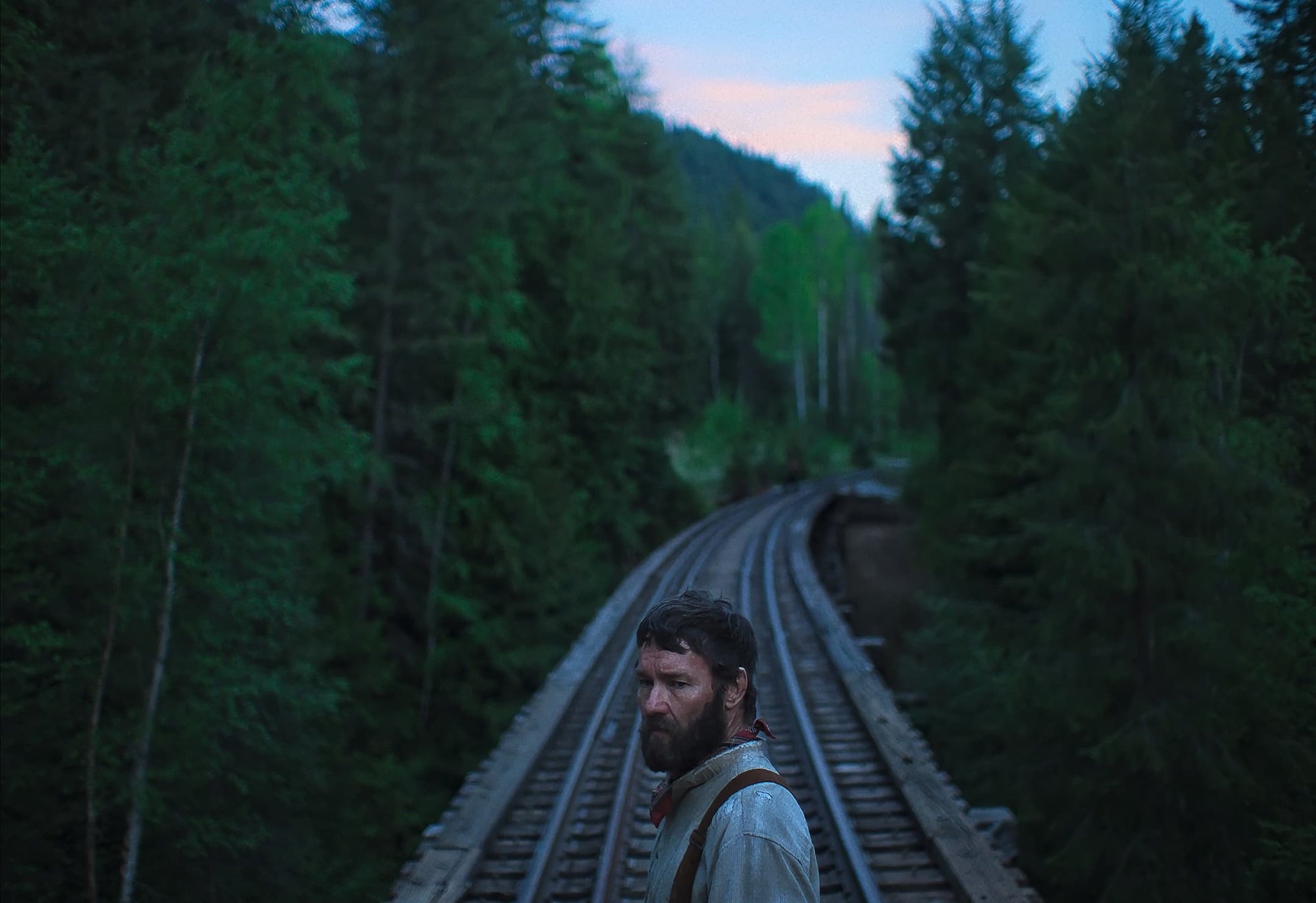
A lot of observation takes place in this movie. Will Patton narrates Train Dreams, though the film only deploys his effective readings as a means to provide some context (with occasional editing choices that add a humorous weight to what we’re seeing, breaking up the tension). Otherwise, however, this is an introspective movie told almost entirely from the perspective of Edgerton’s Robert. This includes factoring in the images he sees of those who affected him in some way but are now gone.
The choices involved in telling this story, adapted from Denis Johnson’s novella, mean approaching this film in a somewhat untraditional manner. While significant events occur, there’s not much of a plot to attach these characters to. Robert deals with different aspects of his life – work, family, and taking in the ways the world is changing – as we follow him over several decades. Making the film is compelling as it comes down to the strength of this central performance, as well as the confidence shown by director/writer Clint Bentley (Jockey) and co-writer Greg Kwedar (Sing Sing).

Coming in at around 100 minutes, this is the sort of film that does enough for us to understand Robert’s journey through life without belaboring the point. There are tangents to some degree, but hardly any time is wasted in understanding which areas had a significant impact. Instead, we get a sense of the love and loss he goes through, while also having moments to appreciate individuals who stuck out to him.
Jones, as Robert’s wife, leans well into the natural chemistry that people in love should have for each other. Later in the film, Kerry Condon shows up as a forestry services worker who relates to Robert in her own unique way. On a more amusing side, Paul Schneider has a brief but effective bit as a talkative logger with a religious bent, only for the character to reach a darkly funny conclusion.

Best of all, however, is William H. Macy in what feels like his best performance in years as another talkative logger who happens to be an explosives expert, as well as one full of folksy advice. It feels like it’s been a while since superb character actor Macy was able to come in for a few scenes and knock it out of the park, but here he is firing on all cylinders to accomplish what’s needed.
Speaking of those truly turning in excellent work, cinematographer Adolpho Veloso’s work on this film is genuinely superb. Shot on 35mm film and presented in the Academy ratio, Train Dreams is no doubt an intimate drama, but it uses its outdoor Washington locations to significant effect. While there’s some flashiness, such as a camera attached to a falling tree, it hardly feels like style for style’s sake. There’s a commitment to all the choices made that really express the preciousness of life, let alone how it plays out for those living in these wilderness environments, unconcerned with how the modern world is advancing.

Key to so much of this is Edgerton, and how well he works as a man who is convincingly physical enough to be a logger who can handle himself, as well as tender enough to be an effective husband and father. Again, as the actor pointed out, so much of life, as observed by the majority of people who do not exist on some fantastical level, relies on experiences that may seem ordinary from another perspective but can be viewed as incredible feats when considered in terms of what truly matters to an individual’s life. Train Dreams finds many significant ways to communicate this while functioning as an effective period drama spanning a long period of time, only to conclude in a truly special manner. It’s all the more fitting, given how special this film as a whole feels.
Train Dreams opens in select theaters on November 7, 2025, and will be available to stream on Netflix starting November 21.