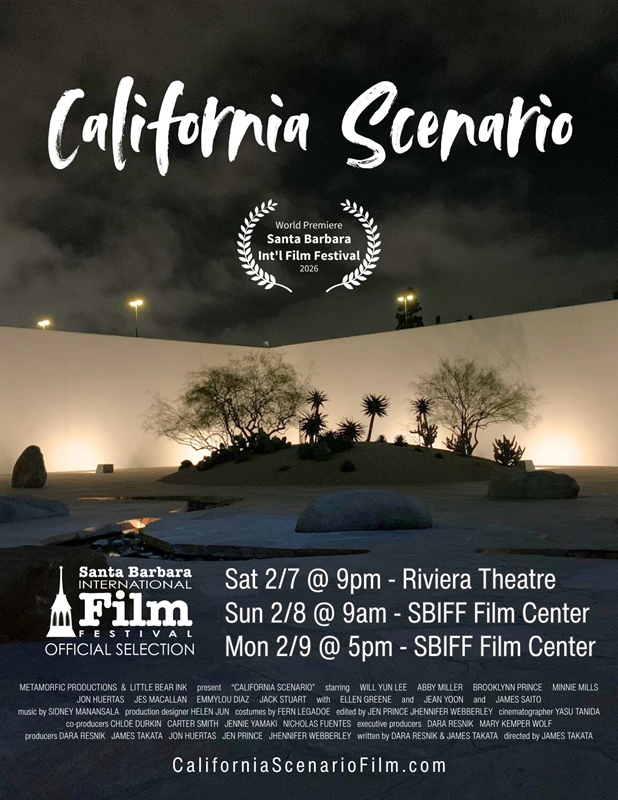
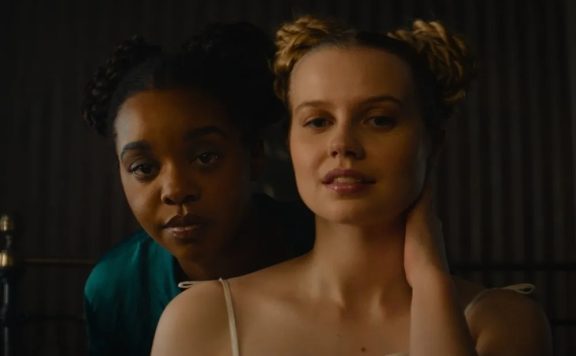
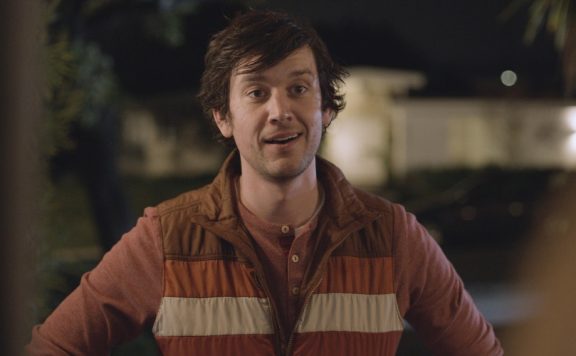
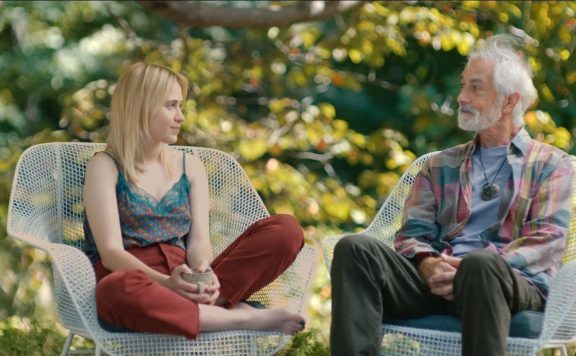
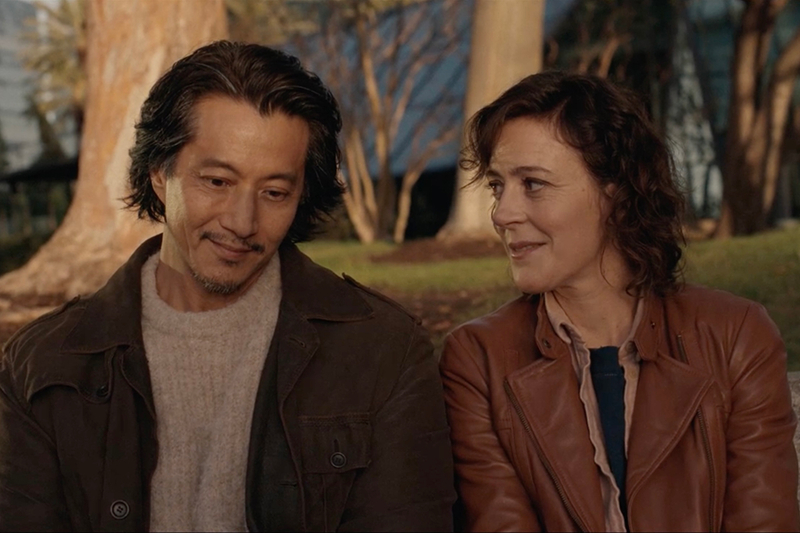
California Scenario, directed by James Takata and co-written by Dara Resnik and Takata, premiered last week at the Santa Barbara International Film Festival (SBIFF). The film, named after the Isamu Noguchi art installation in Costa Mesa, centers on Jacob Hara (Will Yun Lee) and Laura Acker (Abby Miller), two freshly divorced, single parents whose healing journeys have been cut out for them. James and Laura each have a soft spot for Noguchi’s California Scenario, and it is there that the film’s ensemble cast gathers.
California Scenario’s lovely cast of characters are all dealing with the human condition and thus struggling in some way, as most people in the year 2026 are. Their individual issues range from divorce, epigenetic trauma, addiction, compulsive behaviors, and PTSD to garden-variety mental illness. The film does not shy away from these conditions, which are more common than most people realize or care to talk about. As a result, California Scenario demonstrates healing and human survival on multiple levels—from the micro to the macro, from the personal to the communal—with plenty of hope to spare.
See Also: Ethan Hawke Honored with the American Riviera Award at the 41st Annual SBIFF
I had the opportunity to sit down with Dara Resnik and James Takata after screening California Scenario at this year’s SBIFF. We spoke about their creative partnership and the ultimate inspiration behind their film. It was easy to imagine what their co-writing process might be like while watching and listening to them finish each other’s sentences and volley ideas back and forth to one another. Here’s a transcript of our interview [edited for clarity]…
We Live Entertainment/Sarah Morisano: So I really, really liked California Scenario. Congratulations on making such a great indie film. I am wondering if you guys could talk a little bit about your creative partnership—you know, how you began working together and then what your creative process was like day-to-day.
Dara Resnik: I hired James as the DP on the television show that I was running for Amazon called “The Horror of Dolores Roach.” And I had interviewed Jon Huertas [a producer/actor in California Scenario]. I had originally interviewed him to be a director on “Dolores Roach,” and ultimately that slot didn’t work out for him. I needed someone to help us bring empathy to our audience’s understanding of a serial killer—who ultimately becomes one—and he said, “You have to hire this incredible DP, James Takata!” We didn’t start dating until the show was over, but our relationship started as a creative partnership. And during that time, James started telling me about his lifelong desire to make a movie about Isamu Noguchi.
James Takata: I’ve been inspired by Noguchi’s work for a long time. I was an art major, and I continue to draw. As an artist, as a Japanese American, as the father of biracial daughters—as someone who sees himself as a citizen of the world—Noguchi’s art speaks to me on many levels. I had been to the installation in Costa Mesa before, but it was Dara’s idea to write something on an indie scale that we could set there, rather than, you know, the epic story of Noguchi’s life.
DR: It was really an organic process. I started writing some scenes from the middle of the movie and showing them to James. His parents were born in an internment camp, and Noguchi checked himself willingly into a Japanese American concentration camp. And so I said, “Well, what if we did something in this space that he created that was influenced by our lives?” and started sending him some scenes from the middle of the movie that were also influenced by his time on “This Is Us,” which James was one of the DPs on. As a showrunner, I have a really specific process for breaking a story for television shows. So this was a lot more of just us passing scenes back and forth, almost building the movie from the inside out.
JT: This is the first time I’d co-written something, and often Dara would have more insight into the story that might be mine, and I might have more insight into the story that might be hers. There was a lot of, I would say, seamless back and forth, where we continued to just sort of build upon each other’s ideas…
DR: And that was true on set, too. It was a really amazing experience for me. Historically, my experience as a female showrunner or producer is, you know, cautiously approaching the director—usually male—figuring out how to say, “I have this idea, but I don’t want to mess with your fragile male ego…” James was just so great. It was really easy and seamless on set as well. He would do a few takes, and then I would say, “What if you tried one that was a little bit like this? I’m sort of thinking about how this went down, maybe in real life, and how do we want to portray that?” I mean that there was no conflict between us on set at all. It felt really good.
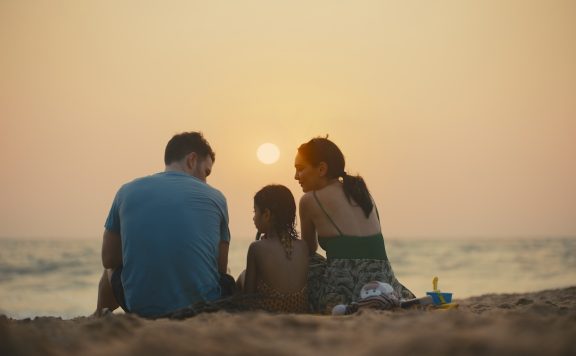
JT: Collaborating creatively and being partners—romantic partners and life partners—only helped, I think, our creative process. And there was very little extra footage that ended up on the floor, and so that’s really, I think, the only way that you can shoot a movie in 10 days for $150,000. We would be doing a lighting setup, and Dara would say, “Hey, what if you grab the camera and take Abby and Brooklynn over here.. You’ve been talking about doing this, you know, silhouette stuff like, you know, run over there and do it.” And so there were a lot of those moments that were filmed during what would have been downtime on a ‘normal’ set. And every one of those shots is in the finale of the movie.
DR: I feel really lucky. I mean, one of the most formative experiences of my producing career was working with Andrea Arnold on “I Love Dick,” and it was just so inspiring—the way that she would grab the camera and a skeleton crew and be like, “Get the train running through town! Go get footage of these three guys in front of that coffee shop who were super authentic…” I think that carrying that experience into this film has been very nice, and I was very lucky to be exposed to her process.

SM: I was a huge fan of “I Love Dick,” so I love hearing that…
DR: That’s really nice to hear that. That show was formative for me. People don’t talk about this, but “I Love Dick” was the first show, to my knowledge, with all female and non-binary folks in the writers’ room. And it was a very trans-inclusive crew.
SM: I didn’t know that, actually, but it’s definitely something you can feel in the storytelling of “I Love Dick” on screen. And yeah, one of my first questions for you both was going to be, “How personal is this film?” I wasn’t aware that you were romantically involved, but there was a moment [while watching California Scenario] where I wondered if it was your origin story, maybe? So that’s interesting…
DR: Well, it is not entirely autobiographical. My parents are not Holocaust survivors, and we took great pains to make sure that the kids’ issues as portrayed in the film are not the exact issues that our children have. We wanted to protect them, but a lot of it is autobiographical, and the feelings are, too. I feel really satisfied with the outcome of, you know, watching this with my divorced friends who are co-parenting with difficult exes and folks who are survivors of concentration camps, saying, “That is my experience,” and feeling really gratified that we got that right.
JT: I think that’s a really great way to put it, Dara, because it really isn’t about the details but the authenticity of the feelings…
SM: Almost like impressionist painting or something…
JT: Yeah, totally, yeah!
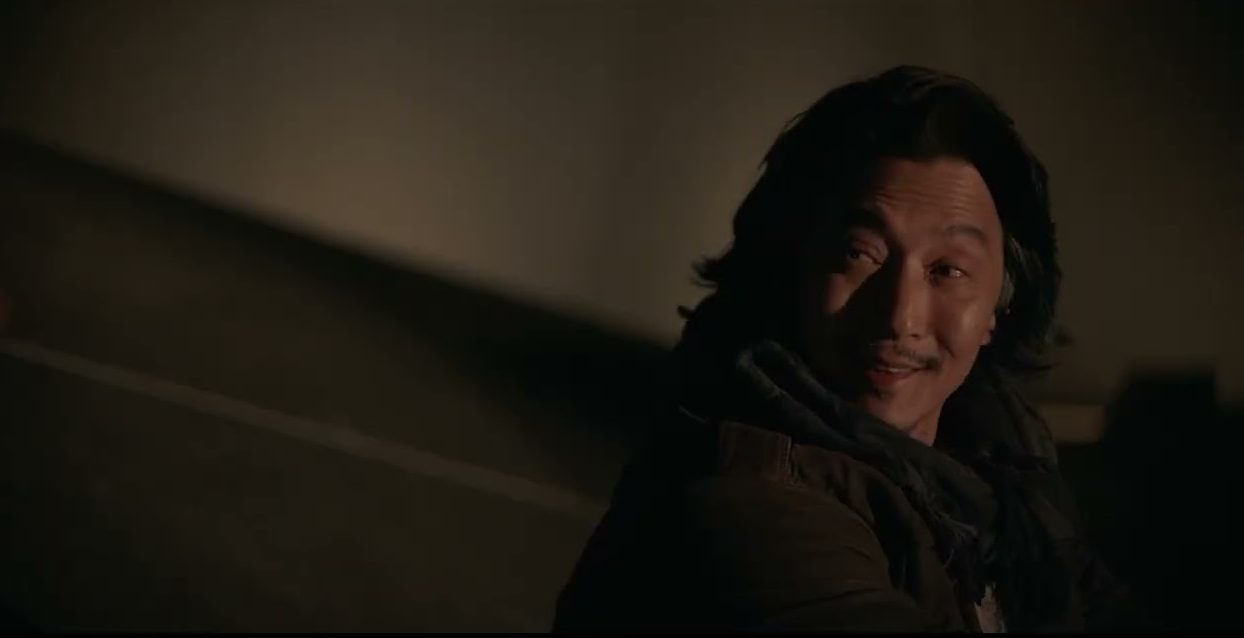
SM: I was not aware of the Noguchi installation, California Scenario, so I enjoyed learning something about art while watching this movie. And, you know, I feel like the internment camps in California do not really get talked about enough. I really enjoyed the detail of, you know, hearing those stories recorded on cassette tapes that the character Lexi later listens to. I was curious how personal that was, or if the cassette tapes were more of a storytelling device?
JT: The way that I learned about camp was a little bit different from Lexi’s experience. It wasn’t hidden. It was talked about, but it was talked about in a very sort of just casual way, right? as it would usually be at a family dinner, or let’s say it was Thanksgiving, and someone would be telling a funny story and suddenly be like, “Was that at camp?” You know, they would always try to place family experiences. “Was it like in camp or out of camp?” And when I was young, you know, I just assumed that that was like some kind of family camp, or like a summer camp that everybody got to go to—and that sounded fun. It wasn’t a secret, but we didn’t delve too deeply into it.
DR: One of the reasons that we grappled with it a little bit in the movie was, as a Jew whose entire 20th-century narrative was brought up, you know, in the shadow of the Holocaust, it was “Never again.” And we have to tell everybody what happened, because if we don’t, it can never happen again. You know, we live. I think the Jewish American community, to some extent, lives, almost over-vocalizing the trauma. And then I would sit at the dinner table with James’ family, and they’d be talking about camp, very much still with that same mode of, “You know, camp!” And I would say to him, “It’s so wild because it’s so different that, like, it’s this trauma that is talked about, but in this very casual way, but never in a way that is like, ‘We have to tell people, because we can’t let this happen again.” That’s one of the reasons I was really eager to make this movie, and unfortunately, it’s gotten even more prescient. It turned out to be prescient because right now there are ICE detainees in former Japanese American concentration camps. So it is something we have to talk about, so people are aware of the history and it doesn’t happen again.
SM: It is wild, unfortunately, how history is repeating itself. And that’s something I also enjoyed about the film—going from the broader history of the family, and American history, world history, to just sort of like each character’s story. It just seems to be telling stories of survival at the macro and micro levels. And I really enjoyed that almost every character’s internal struggle was represented in some way on screen. It felt very much like an ensemble, almost like an episode of “This Is Us” or “LOST.” And I am curious why it was important to you to represent the characters that way, rather than just focusing on the two leads.
DR: One of the things that has always struck us—and it’s something that we’ve talked about quite a bit—is the way that various people in our.. I mean, we never thought that Jon Huertas was going to be the person who introduced us to the loves of our lives, right? People come in and out of your life, and they affect your life in very different ways. And everything that happened in that person’s life that brought you to be moved towards this other person also got them there, which then pivots them into some other place… There was a great exhibit about Noguchi’s work at the Clark Museum last year, and it discussed how he didn’t believe in linear time. He really believed the past, present, and future were sort of simultaneously happening at once. And so if all of these people, these characters, were there in that installation, then all of their pasts, presents, and futures were also simultaneously happening. And how could we show what happened in their past that then influenced them to be there in this very present moment? And how do they change as they move into the future? It was a way for me to honor James’s vision and his love for Noguchi, and also to keep it small and be able to shoot for those four days in the California Scenario installation.
JT: Memories can sometimes be like intrusive thoughts. It’s a smell, it’s a sound, it’s seeing a thing or being in a place that just brings that memory back—and that’s how a lot of our characters experience those memories. Being in the installation, you know, I think as soon as we were there and scouting it, those white walls just called out to be projected on. And so those, you know, a lot of those things were actual family photos of my great grandparents, or, you know, the railroad that my great grandfather actually worked on. My family wasn’t at Manzanar, but, you know, you get the point.
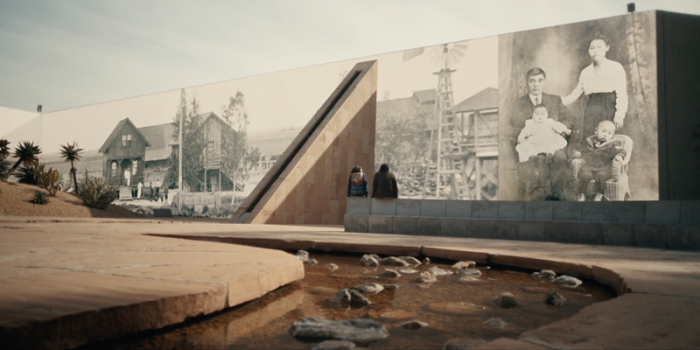
SM: You mention past, present, and future…. I think that’s super interesting, the way that all connects to the art installation. Something that I noticed in the film is that the flashbacks have a different color palette. So, what do the different color palettes represent for you between the past and the present?
JT: There was a balance between confusing [our audience] and making sure that people understood that this was, in fact, a flashback.
DR: Like we were talking about early on, like James said, a memory can feel like an intrusive thought, right? Especially if you have PTSD, it feels like your memories are happening presently, and it is almost confusing. So there was some playing, as James alludes to, with how deep to go into those color palettes.
JT: The color change for the flashbacks was a cooler, more subdued palette. We also added quite a bit of grain—like film-style grain — to it. And the corners of that box—that 4:3 aspect ratio box—were rounded in the flashbacks. The present day, which was sometimes everything outside of the flashbacks and the flash-forwards, was also in 4:3—but with sharp corners. And that was a choice to sort of show how the characters’ lives were more constrained, and how when they got to the installation, it literally, you literally see the frame open up into 2:1 and it speaks to, you know, the possibilities of of healing and the possibilities of their future…
DR: …and the way that art expands our horizon, expands our world. It felt so right. And when James came up with that idea, and I just thought it was very cool to watch him in real time, you know, come up with them going through the trees, and the trees expanding the frame.
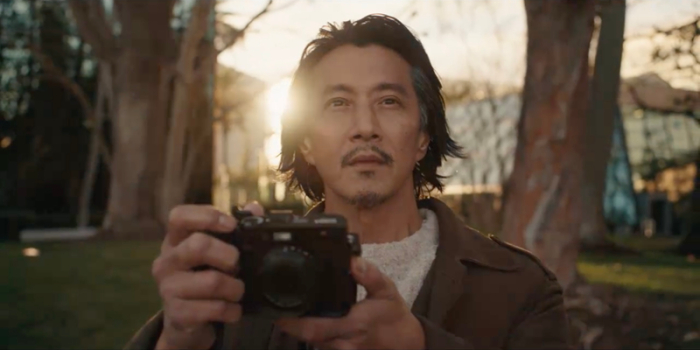
SM: That’s beautiful. I love how intentional your choices were to represent time like that onscreen. So, my last question, I really loved the ending and the way it tied everything together so beautifully. And I was just curious how you both arrived at that portrayal?
DR: As I said, we started in the middle of the movie and worked our way out. I am a little bit of a poet and have published some poems, and there was something about that last piece where we were working our way towards it, almost sort of like poetry. Ultimately, what you see is not exactly what it was when I first wrote it, but I do think it has turned out to be the perfect bookend for our film. I’m very happy with the way it turned out. It was pretty magical. We shot it at sunrise after a very rainy day, and it’s almost like you can feel that in the movie.
JT: Dara wrote just the most beautiful poem, and being able to shoot that, as she said, at dawn in the art installation, where you can see the actor’s breath. And the way that installation relates to the sun is actually like a very extended sunrise. And so Jacob and Laura are the first ones who are in the sun as the sun rises. It’s probably like a good hour and a half as the sun starts to creep across the plaza. And so we actually had the opportunity to shoot all our actors during an extended sunrise. So everybody got to really experience that.
DR: I think that’s why it’s not just the words that make it feel hopeful. It’s the fact that you’re watching the sunrise. It reminds you that even through this really dark night, these characters lived to see the sun rise on another day—and they can try again.
SM: That’s amazing. That’s fantastic. Thank you. Dara, where can people read your poetry?
DR: The one that most recently came out is a book called Teacakes and Tarot: An Anthology by Spell Jar Press. It’s an anthology of tarot poetry. So thank you for asking!
SM: All right. Well, thank you both so much for your time—and again, congratulations. I really, really enjoyed your film. So thank you.
DR & JT: Thanks Sarah, we appreciate it!
Learn more about the film at the official California Scenario website.
The 41st Santa Barbara International Film Festival took place from February 4 to February 14, 2026.