South African actress Embeth Davidtz’s directorial debut is well-made in style and ambitious for a first-time feature, especially in the shots that balance the somber and melodramatic tone. This perceptive narration by Lexi Venter provides a significant amount of exposition, reminding us that this adaptation is based on a novel, but keeps the story moving along at times when it feels slow. If the movie has its limitations, it is the storytelling perspective centered on white characters in an African country.
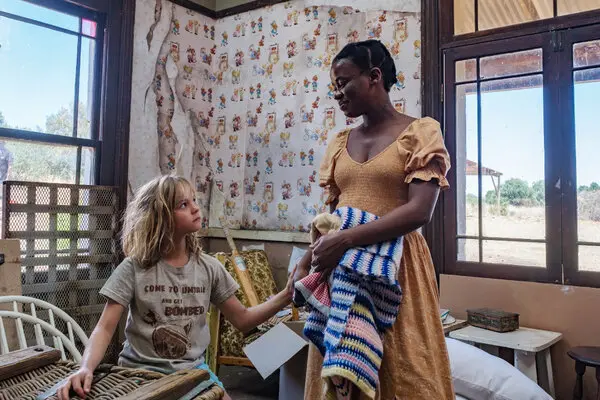
However, the strength of Don’t Let’s Go to the Dogs Tonight comes from the lead actress, Lexi Venter, as seven-year-old Bobo, who is compelling and commands the screen in every scene. This would feel like a different movie experience without her. The childlike innocence of observation was on full display, and Davidtz’s direction excels at capturing her perspective of the world around her. (Her commenting that two adults in a separate room “are drinking brandy and moving furniture with their clothes off” provides a unique perspective.) Another interesting scene is where she plays house with African kids, but they serve as a reminder that racism is learned. Shots of her watching adults dance or talk, or conversational frames, her as a child at a distance to them, but observing it all.
See Also: ‘Moffie’ Review: A Beautiful Yet Brutal Story of Queer Identity in 1980s South Africa
Don’t Let’s Go to the Dogs Tonight leans in on both sentimental and jarring memories of the country she ultimately left behind. It does a good job of placing the audience in the home and country, with a striking mood and setting. A terrific emotional moment occurs when the girl is under the table, and the camera shows her perspective from below as her white Rhodesian farmer parents struggle with both the domestic conflict in their house and a transforming society. It is this moment I have thought about when I saw it last year at the Telluride Film Festival, and it has lingered in my mind since then.
Don’t Let’s Go to the Dogs Tonight is now playing in limited theaters.