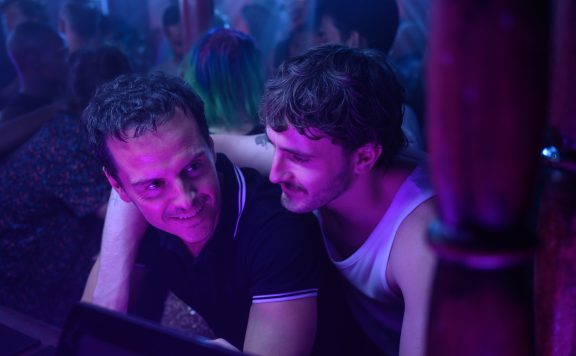
In Plainclothes, Tom Blyth delivers an affecting performance as a man torn between accepting his sexuality and enforcing laws that punish others for it, but he’s trapped in a film that shifts styles like channels on a broken TV, never settling on a clear identity.
The film centers on Lucas (Blyth), a young police officer in 1983, tasked with entrapping gay men at a local mall for indecency. The problem is that he himself is grappling with his own sexuality. When he meets Andrew (Russell Tovey) – a man he should be entrapping – his desire for him overtakes his duty to arrest him. Lucas’ obsession spirals quickly, creating problems not only for himself but for Andrew’s closeted life as well.
See Also: ‘Twinless’ Review: Dylan O’Brien Delivers a Breakout Performance in This Hopeful Drama

Lucas belongs to a loud New Jersey family with rigid ideas about how people should behave. His mother, Marie (Maria Dizzia), has just lost her husband Gus and is left managing her grief while corralling a chaotic household. Between his family pressures and societal bigotry, Lucas suffocates in the closet, and we ache for him to see that things could get better if only he accepts himself. But this is the early ’80s, and with the AIDS epidemic looming, tolerance for gay ment sup is in shorply.
This is writer-director Carmen Emmi’s first feature, and in some ways it shows. He throws every visual trick into the mix – different aspect ratios, handheld cameras, VHS textures – sometimes all in the same sequence, often without clear purpose. The 1983 timeline appears in 16:9, while flashbacks take on a 1:1 ratio. We see flickers of past, future, feelings, and abstract emotions, but instead of cohesion, it feels like Emmi raiding a new toy box of visual flourishes just to try them all. It becomes more distracting than illuminating.

The story leans on a well-worn trope that dominated gay cinema of the late ’80s and ’90s: the bleak struggles of life in the closet, steeped in shame, abuse, and societal rejection. Layer onto that an overbearing family dynamic, a mistaken-identity subplot that feels contrived, a long-suffering but supportive ex-girlfriend (a movie in itself), and a budding sexuality that quickly curdles into obsession. It’s all too much at once, with too little meaningful exploration to make it resonate. As a result, Plainclothes is a jumble of ideas that doesn’t add anything new to that conversation. For gay audiences, this feels like a “been there/seen that” retread. At best, it seems more tailored to an indie straight audience unfamiliar with the terrain.
Still, Blyth is terrific. His fear, yearning, and eventual obsession with Andrew ring true. When you’re discovering your sexuality and find the one person who mirrors your desires, tunnel vision can take hold – and Blyth conveys that vulnerability beautifully. Dizzia, as his worn-out mother, is also quite good here and gives the film a final moment that is one of the best, most revealing messages in the movie.

Tovey, however, falls short. As Andrew, he once again embodies the gruff, straight-acting gay man (closeted here), layering his performance with a guttural, performative masculinity that feels more done for personal reasons than an actor’s choice for a character. It’s a pattern in his U.S. work since HBO’s Looking; a need to prove toughness at the expense of nuance. His Andrew remains a grunting blank slate, with his only real softness confined to a letter we hear about, but never actually see onscreen.
With its frenetic style that adds little, a narrative that feels dated, and a supporting performance that borders on posturing, Plainclothes fails to deliver an arresting take on a difficult time. What remains is Blyth’s heartbreaking performance; one that deserves a better film around it.
Plainclothes opens in limited release on September 19, 2025.