It’s a real joy to watch large-scale sci-fi movies where all the characters are smart and inherently good. Project Hail Mary functions much in the same way as Ridley Scott’s The Martian for obvious reasons (it’s based on another Andy Weir book that Drew Goddard has once again adapted), but there’s still that same core element that hasn’t been rewritten for the sake of clichéd dramatic developments. This is a film about intelligent people doing all the science they can to save the universe. Yet it’s a credit to the filmmaking and to star Ryan Gosling that there’s still enough intimacy in how this is accomplished that the stakes don’t feel too gargantuan to consider. Yes, it’s a lot to think about, but grounding things through humor and maintaining a sense of adventure helps this gorgeously presented film play as a smart crowd-pleaser that’s sure to satisfy just about anyone.
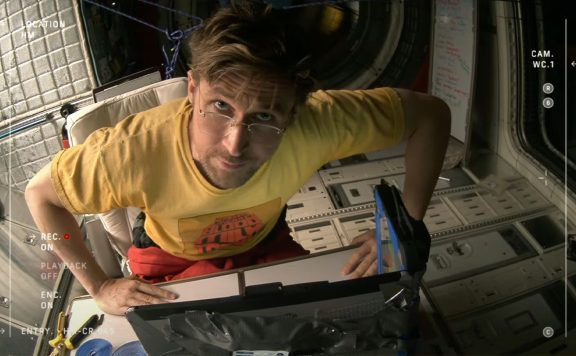
Gosling stars as Dr. Ryland Grace, a middle school science teacher who awakens on a spacecraft lightyears away from home with no memory of what’s happened. How did he get here? The film slowly fills us in on all the details, interspersing flashbacks (presented in widescreen) of Grace being recruited for a classified mission. In contrast, his current situation (presented in full IMAX ratio for those who see it on these screens) finds him rediscovering his objective. As we come to understand, stars across the universe, including our son, have been infected by something, and the answer as to why may lie in a far-off solar system. However, while Grace’s scientific ingenuity will hopefully aid him significantly, he may also be getting additional help from something else with a similar objective.
See Also: ‘The Bride!’ Review: Horror’s Shiveriest Sensation Returns

There shouldn’t be much need to beat around the bush here. As much as one could lean into describing Grace’s situation as a solo journey that forces him into reluctant hero mode, this is really a movie about companionship. With that in mind, yes: Grace encounters an alien he dubs Rocky (co-performed and voiced by James Ortiz), and the two spend much of the film working together to solve the dilemma facing their worlds. Thanks to Gosling’s portrayal of the role and the way Rocky is visualized, Project Hail Mary accomplishes a lot by playing up the strangeness of this new creature, the quirkiness of their relationship, and the emotion of what their bond ultimately means to each of them. That’s no easy feat, and yet here we are.
Project Hail Mary comes from directors Phil Lord and Christopher Miller, whose efforts in animation (The Lego Movie, Cloud with a Chance of Meatballs, the Spider-Verse films as producers/writers) do a pretty fantastic job in allowing for a film to find visually compelling ways to not only capture space but create an atmosphere rooted in what Grace is physically and psychologically going through in a given moment. That’s especially important when the film finds creative ways to push back into the past through various match cuts and other signifiers, tying those flashbacks in ways that are more than just a time limit that requires us to check in elsewhere.

Not to discount Lord and Miller’s live-action efforts with the Jump Street movies, it is the film’s subversive sense of humor that also makes Project Hail Mary as enjoyable as it is. No, this isn’t the same as an R-rated buddy cop comedy. Still, between Weir/Goddard’s writing and these directors’ own sensibilities, chances are taken to play on what Gosling is naturally able to do and what can be created out of either the situation in space or the supporting characters on earth that give the movie a chance to breathe, allow the cast to feel more human, and engage with a core theme that hovers over the film – our worlds are not perfect.
It’s fascinating to see how films like this can take elements of reality and inject them into doomsday scenarios in a way that sounds plausible. In return, along with the ecstasy of watching these characters solve the problem, we get a journey rooted in the idea that they must deal with the imperfection of things. A well-written film can find multiple ways to apply this to the drama. Apollo 13, for example, does what it can to explain the actual issues that occurred on that mission, while also developing the characters further through the imperfections that led to everything happening the way it did, including leaving a key crewmember out due to a false measles prediction.

In this film, Grace is where he is before launching into space because he dared to question established theories with his own ideas. Sandra Hüller’s (terrific as always) Eva Stratt, the head of the project, appreciates this about Grace, which gets him the position he has and allows him to study what’s been unexplainable thus far. Further revelations have led us to understand that solving this problem requires sacrifice and measuring one’s self-importance against the fate of the world, and that’s on top of the idea of using a plan with millions of potential issues.
Given the lighthearted nature of most of this film, all things considered, I could see a possible issue in how much danger is truly presented. It’s maybe a valid point if one wants to take the story unfolding seriously. Still, I suppose my counter would have to focus less on making the argument that one must accept the journey presented and more on why we are locked into these specific characters. What is it that makes Grace, Stratt, and Rocky central to all that we are seeing? A clear objective is just that, but a film as clever as this knows what there is to gain by pushing those relationships to certain limits that, again, speaks to the notion that taking such an uncertain shot at fixing a major problem means relying on the very unpredictable nature of an imperfect system to work in one’s favor, ideally.

That sort of idealism brings this all back to why I can easily admire a movie like Project Hail Mary. There’s no need for a villain. Attempts to push characters out of their comfort zone arise from organic developments in the story rather than manufactured drama. The film and the people we are dealing with have too much intelligence established early on for it to veer into unnecessary directions. As a result, it also means not getting distracted from the beauty on display. Greig Fraser’s cinematography is terrific. Daniel Pemberton’s score is full of ways that capture the wonders of the moment. The visual effects seamlessly blend practical creature and production design with fine uses of CG and other digital trickery to pull this concept off.
At a time when attitudes toward science are shifting for some due to bad-faith arguments, Project Hail Mary is here to explore why relying on education and the scientific method can be cool to watch. While serving as a perfect movie-star vehicle for the very talented Gosling, he doesn’t shy away from showing off what it means to have a focused mind that can balance his sense of humor with the notion of using factual data to build new ideas and theories rooted in foundational science. That this all goes into a film about solving a problem with the state of the universe that also brings in the notion of intelligent life just speaks to how willing this screenplay is to pack in so much, and yet to know how to pull it all off. Project Hail Mary has plenty of movie to offer for audiences, and the only rocky thing about it would be to not take advantage of seeing such a film on the big screen.
Project Hail Mary opens in theaters and IMAX on March 20, 2026.